On this page
- 1. How Many Days Do You Really Need?
- 2. The 5-Day Itinerary: Marrakech, the Atlas and the Agafay
- 3. The 7-Day Itinerary: Kasbahs, Gorges and the Sahara
- 4. The 10-Day Itinerary: Sahara, Fes and the Blue City
- 5. What Makes Any of These Journeys Luxurious
- 6. Season, Booking and Making It Yours
- 7. Frequently Asked Questions
The question we hear most often from luxury travelers isn't about hotels or thread counts. It's simpler than that: how many days do I actually need, and what can I see without spending the whole trip in a car? It's a fair worry, because Morocco is bigger than most first-time visitors expect, and the gap between a well-paced week and a rushed one is mostly a matter of route.
Below are three private itineraries, of 5, 7 and 10 days, built the way we'd plan them for a guest who wants to arrive rested and leave wanting more. They are sample routes rather than fixed packages, and each can be reshaped around your dates, your pace and the properties you prefer. Here is what we've seen work, and what doesn't, since 2011.
How Many Days Do You Really Need?
The honest answer depends on one decision: do you want to reach the Sahara dunes? Marrakech, the Atlas foothills and a first taste of the desert fit comfortably into five days. The dunes of Merzouga are a long way from Marrakech, and they need at least seven days if you don't want to spend most of them on the road. Add the imperial cities of the north and you are looking at ten.
The table below summarizes the three routes. Driving times are typical figures without stops and vary with traffic, weather and how often you ask the driver to pull over, which on a private tour is as often as you like.
| Length | Route | Nights | Longest drive | Best for |
|---|---|---|---|---|
| 5 days | Marrakech, Atlas Mountains, Aït Benhaddou, Agafay desert | 4 | About 4 to 5 hours | A short first visit, a long weekend extended, no Sahara dunes |
| 7 days | Marrakech, Aït Benhaddou, Dades Valley, Merzouga | 6 | About 5 to 6 hours | A first visit that includes a night in the Sahara |
| 10 days | Marrakech, Merzouga, Fes, Chefchaouen, Casablanca | 9 | About 7 to 8 hours, split with a long lunch | The full first-time circuit, from the desert to the imperial cities |
The 5-Day Itinerary: Marrakech, the Atlas and the Agafay
Five days is the sweet spot for travelers who want a real sense of Morocco without committing to a long drive south. The route stays close to Marrakech, crosses the High Atlas on one of its most scenic roads and ends with a night in the stony desert on the city's doorstep.
Day 1: Arrival in Marrakech.
Your driver meets you at the airport and takes you straight to your riad or hotel. Nothing is planned beyond a quiet evening, perhaps dinner on a rooftop terrace with a view over the square.
Day 2: Marrakech at an unhurried pace.
A private guide takes you through the morning, when the medina is calmest: a palace, the souks and a garden, with tea breaks built in. The afternoon is yours for a spa, a hammam or simply the pool.
Day 3: Over the Atlas to Aït Benhaddou.
The road climbs over the Tizi n'Tichka pass and drops into the pre-Saharan valleys. The ksar of Aït Ben Haddou, a UNESCO World Heritage Site, is described as a traditional pre-Saharan habitat of earthen buildings behind high walls. You spend the night in a kasbah-style hotel nearby.
Day 4: Back through the mountains to the Agafay.
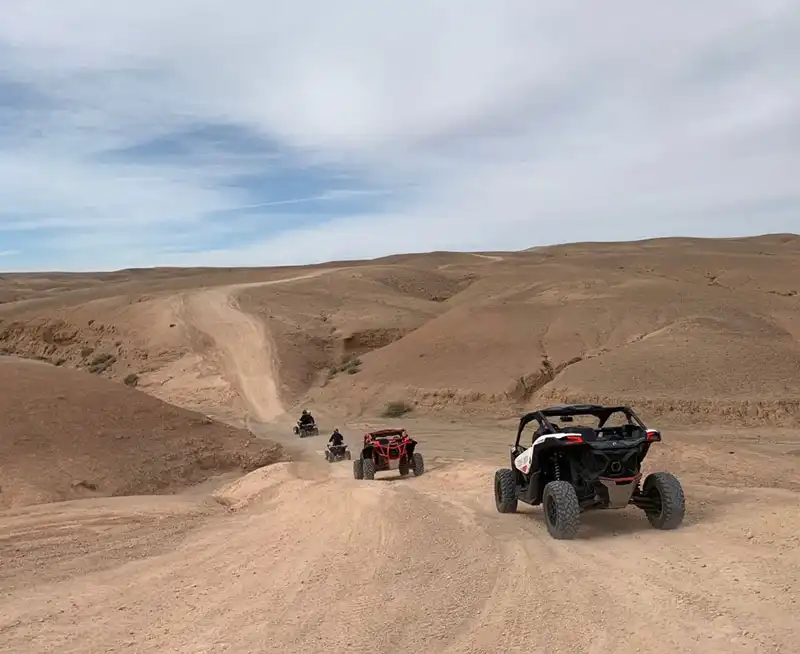
A slow morning, then the drive back toward Marrakech and on to a luxury camp in the Agafay desert for sunset, dinner and a night under the stars. The two deserts are often confused, so to be clear: the Agafay is a rocky plateau rather than a sea of dunes, but it is close, quiet and very atmospheric. With only a short stay in Marrakech, the same landscape works as an overnight excursion in the Agafay desert or a sunset dinner in the Agafay.
Day 5: Farewell to Marrakech.
Breakfast without an alarm clock, then a private transfer to the airport at the time that suits your flight.
If you prefer the sea to the mountains, swap Days 3 and 4 for two nights in Essaouira, a walled Atlantic port with a flatter medina and a sea breeze. You can compare other options among the 5-day Morocco tours.
The 7-Day Itinerary: Kasbahs, Gorges and the Sahara
Seven days is the shortest length at which the Sahara makes sense, and it deserves a straight word: this is a driving week. Two of the days are long. What makes it worthwhile is that the road itself is the attraction, with mountain passes, palm valleys, kasbahs and gorges between you and the dunes, and a private driver turns those hours into part of the experience rather than a chore.
Days 1 and 2: Marrakech.
Arrive, settle in and spend a full day in the city with a private guide, as in the 5-day route. Two nights in the same place means you unpack once and start the drive south rested.
Day 3: Marrakech to the Dades Valley.
Cross the Atlas, stop at Aït Benhaddou for a walk and a long lunch, then continue along the road of a thousand kasbahs to your hotel in the Dades Valley. The drive is about five to six hours, spread over the whole day.
Day 4: Gorges and dunes.
A short stop at the Todra Gorge in the morning, then on to Merzouga in time to reach your private camp at sunset. This is the night that justifies the whole journey: proper beds, an en-suite tent and the silence of the dunes. The camel ride is optional.
Day 5: Sunrise and the road back.
Watch the sunrise over the dunes, have breakfast at camp and drive back toward Ouarzazate, where you spend the night.
Day 6: Ouarzazate to Marrakech.
The last drive is a short one, about four hours, which leaves the afternoon for a final spa or a stroll through the souks and a farewell dinner.
Day 7: Departure.
A private transfer to the airport.
If long drives aren't for you, a seven-day trip also works without the Sahara: three nights in Marrakech, two in Essaouira and one in the Agafay, with no drive over three hours. The 7-day Morocco tours show other ways to shape the week.
The 10-Day Itinerary: Sahara, Fes and the Blue City
Ten days is the length at which Morocco starts to feel complete. You see the desert, the kasbahs, two imperial cities and the blue mountain town of Chefchaouen, and you still have rest days built in. It is also the route where pacing matters most, because the temptation is always to add one more stop.
Days 1 and 2: Marrakech.
Two nights, one full day with a guide, as above.
Day 3: Marrakech to the Dades Valley.
Over the Atlas, lunch at Aït Benhaddou and a night in a quiet hotel in the valley.
Day 4: Gorges and a night in the Sahara.
Todra Gorge in the morning, Merzouga and a private desert camp by sunset.
Day 5: Merzouga to Fes.
The longest day of the trip, about seven to eight hours. We break it at the cedar forests around Azrou or Ifrane for a proper lunch, so the journey feels like a crossing of the country rather than a transfer. You arrive in Fes in the evening.
Day 6: Fes.
A full day in the medina with a guide who knows which lanes to take and where to sit down. The medina of Fez is described by UNESCO as one of the most extensive and best conserved historic towns of the Arab-Muslim world, and half a day is enough to feel it. The Fes medina is also the most tiring walk of the trip, so we keep the afternoon free.
Day 7: Fes to Chefchaouen via Meknes and Volubilis.
A scenic day with two optional stops. The archaeological site of Volubilis preserves the ruins of a Mauritanian capital that later became an important outpost of the Roman Empire. Skip Meknes if you'd rather arrive earlier in Chefchaouen.
Day 8: Chefchaouen.
A deliberately light day. Wander the blue lanes in the morning, then rest. This is the pause in the trip, and it is worth protecting.
Day 9: Chefchaouen to Casablanca via Rabat.
Drive to Rabat for the Kasbah of the Udayas and the Hassan Tower, then on to Casablanca, about an hour further. The Hassan II Mosque is a fitting last sight.
Day 10: Departure from Casablanca.
A private transfer to the airport.
Because this route starts in Marrakech and ends in Casablanca, there is no backtracking and no repeated roads. If you prefer to fly into Casablanca and out of Marrakech, the route simply runs in reverse. Browse the 10-day Morocco tours for other versions, including routes that begin from Casablanca or Tangier. Wondering how much walking Morocco really involves? The Fes medina is the main effort on this route, and any medina visit can be shortened on the day.
What Makes Any of These Journeys Luxurious
Length doesn't make a trip luxurious. Rhythm does. On all three routes we follow the same few rules: two nights in the same place wherever the route allows it, no more than one long drive in a row, a proper lunch stop rather than a roadside sandwich, and one lighter day after each demanding one.
The second ingredient is where you sleep. A riad in the medina gives you atmosphere and a short walk to the sights, while a full-service hotel gives you space, a larger spa and a pool, and the best itineraries mix a riad and a hotel across the same trip. The desert night is the other place where the extra investment shows. A private luxury camp near Merzouga with proper beds and an en-suite tent is a very different night from a shared camp.
The third is the vehicle. On a truly private tour, the car, driver and pace are yours alone, so a long lunch or an unplanned stop at a village market costs you nothing. Many travelers wonder whether a private trip costs more than a group tour, and the answer depends on what is included. Our luxury Morocco tours are all built on this private model.
Season, Booking and Making It Yours
Spring (March to May) and autumn (September to November) are the best windows for all three routes, with mild days in the cities and manageable desert heat. The right month also depends on where you are going, and the best time to visit Morocco differs between the north, the coast and the desert. Winter works well for the 5-day route, though desert nights are cold, and Morocco in December is a popular choice for festive trips. We'd avoid the south in July and August, as explained in the Morocco summer travel guide.
On timing, booking two to three months ahead is comfortable for most dates. The best riads and desert camps can fill four to six months ahead in spring and autumn, so book earlier if your dates are fixed.
Entry rules depend on your nationality. As an example, the FCDO's entry requirements for Morocco, written for UK passport holders, state that you can visit without a visa for up to 90 days for tourism and that your passport must be valid for at least three months after arrival. Check the official guidance for your own country before you book, and a short list of what to do before travelling to Morocco covers the rest.
None of these routes is fixed. You can swap the Sahara for the coast, add a night in a mountain retreat, or turn the 10-day route into a honeymoon in Morocco with extra time at each stop. Traveling with children? The 5-day, 7-day and 10-day family itineraries adjust the pace and the stops for younger travelers.
Frequently Asked Questions
How many days do I need for a luxury trip to Morocco?
Five days is enough for Marrakech, the Atlas and a night in the Agafay desert. Seven days is the minimum for a night in the Sahara at Merzouga without rushing, and ten days lets you add Fes, Chefchaouen and the coast with rest days built in.
Is the Sahara worth it on a 7-day trip?
Yes, if you accept two long driving days. The route passes Aït Benhaddou, the Dades Valley and the Todra Gorge, so the drive is part of the experience. If you'd rather avoid long drives, the Agafay desert gives you a desert night within an hour of Marrakech.
What is the difference between the Agafay and the Sahara?
The Agafay is a rocky, stony plateau near Marrakech, with views of the Atlas and a quiet atmosphere, while the Sahara at Merzouga offers the tall dunes of Erg Chebbi most people picture. The Agafay is easy to reach from Marrakech, and the Sahara needs at least seven days to reach comfortably.
Can I start in Casablanca or Fes instead of Marrakech?
Yes. The routes run equally well in reverse or from another city, and we build them around your flights. Starting and ending in different cities avoids backtracking and often saves a full day.
Are these itineraries suitable for older travelers?
They can be adapted. The 5-day route and the coastal version of the 7-day route involve the least walking and driving. For the longer routes, we shorten medina visits and add rest days.
Can I change the itinerary once I'm there?
Yes, within reason. The framework, meaning the vehicle, the driver and the key properties, is arranged in advance, but the pace of each day stays flexible. Extra time in a souk, a changed restaurant or a slower morning is what private travel is for.
Written by
Said, Senior Guide and co-founder of Morocco Tours. A former mountain guide, Said has been a guide certified by Morocco's national tourist office since 2009.
Every luxury journey starts with a different set of priorities. Tell us your dates, how long you have and which of these stops appeal to you, and we'll shape the itinerary around it.
Explore Luxury Morocco Tours → · Plan a Private Trip →
You may also like: How to Plan a Luxury Morocco Tour? · What is the Best Time to Visit Morocco? · Marrakech Travel Guide