 BestsellerBestseller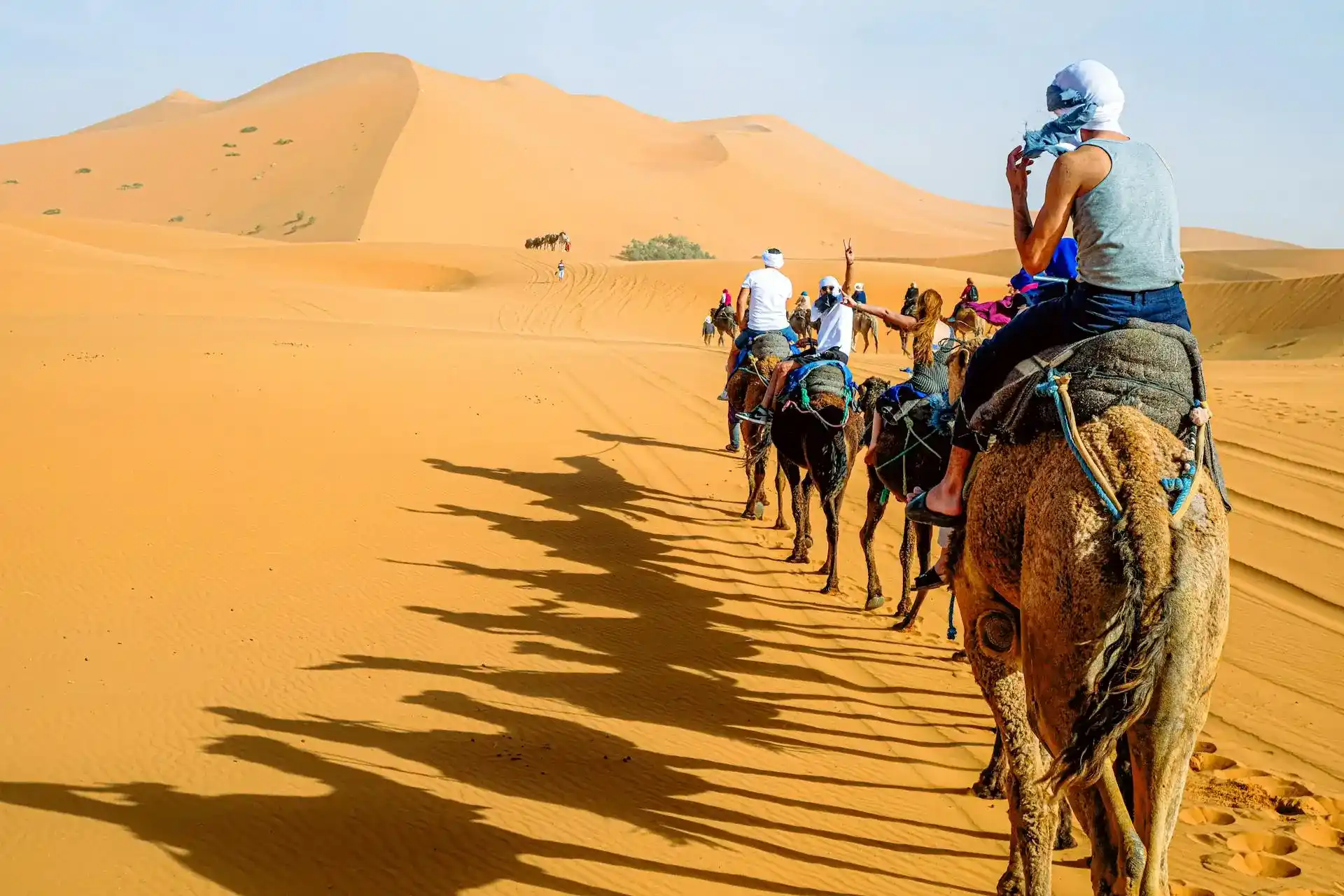
Travelers' top picks among our Moroccan dune tours: Different durations, different departure cities, including a luxury option. All private and customizable.
Bestseller 14% Off
 Adventure
 Deep immersion
Most Morocco itineraries put the desert at the southern end of the loop. Once you cross the High Atlas at dawn and descend through palm valleys past Erfoud, you can feel why. The road narrows, the last tourist buses peel off, and the Moroccan Sahara is where the pace finally drops.
By late afternoon, a camel walks you the last hour into the dunes. The only sounds are wind, your own footsteps, and the shuffle of the camel ahead of you. The colour of the sand shifts through the day. Pale gold at midday, deep amber close to dusk, then a brief minute when the dunes turn violet against the first stars.
Camp nights are what most people end up talking about afterwards. You eat inside a Berber tent built and run by the same family for years. The mint tea gets poured from height so it foams in the glass. After dinner the drums come out, and at this latitude the constellations look denser than they do from Europe. Sunrise is worth the early alarm. The shadows on the dunes are at their longest in those first ten minutes, which is why photographers set their alarms for it.
For the past fifteen years, we have been organizing Sahara desert tours from different Moroccan cities, from the Erg Chebbi dunes near Merzouga village to the wilder Erg Chigaga past M'Hamid. We handle the itinerary, the vehicle, the camp, and the meals. Your job is to bring the time.
The Moroccan desert isn't just one place. There are four major dune fields in the south, each with its own access, its own scale and its own crowd. Here's how to choose the right one for your trip.
The postcard dunes. A spectacular 50 km² expanse of red-gold sand rising to 150 meters with sharp-crested ridges, and the most photographed Sahara in Morocco. Paved road right up to the edge, 9 hours from Marrakech, 7 from Fes. Camps from budget to luxury, accessible on a 3-day tour.
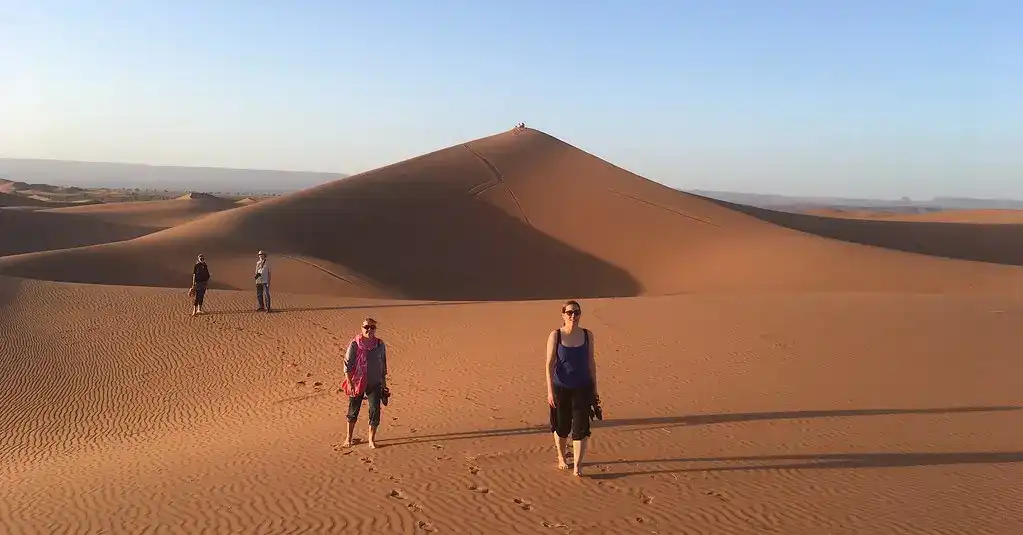
The biggest dune field in Morocco — 40 km long, dunes up to 300m. No paved road in: 60 km of off-road through Lake Iriqui salt flats from Foum Zguid, or the longer M'hamid track. No day-trippers. Camps are smaller, quieter, more remote.
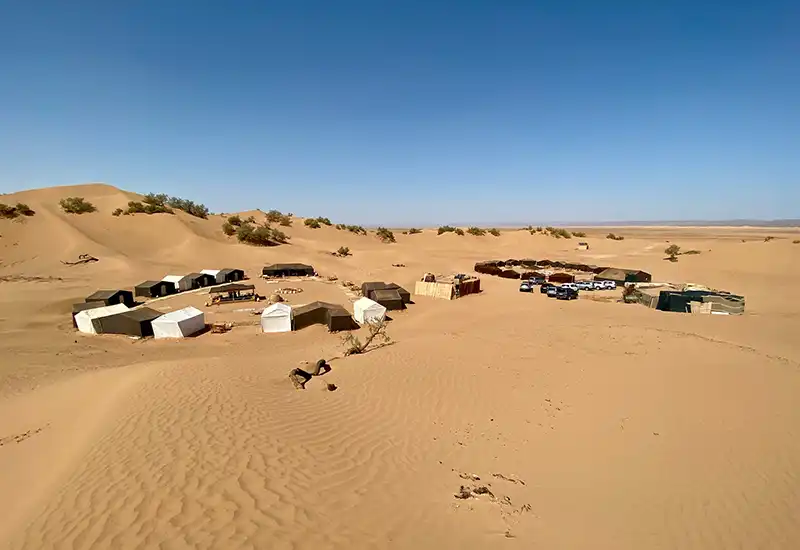
Locals call them ''the Jewish dunes'' golden ridges 15 km north of M'hamid El Ghizlane, the last village before the open Sahara. Smaller than Erg Chebbi (around 50 m high), they can be reached in just a 30-minute 4x4 drive from M'hamid. Quiet and intimate, they are chosen when Erg Chigaga is fully booked.
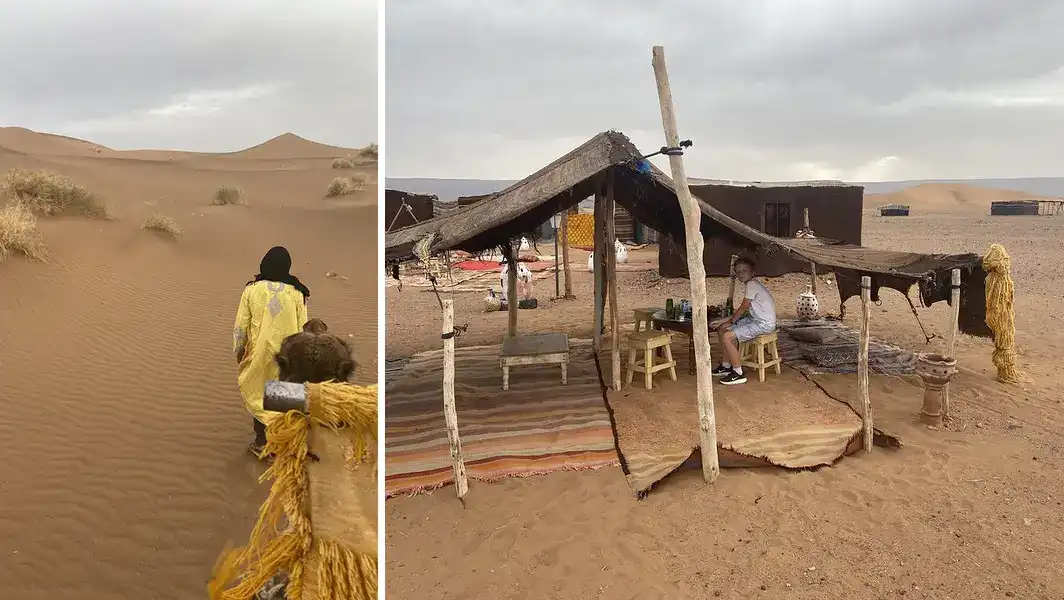
Small, isolated dunes 25 km south of Zagora, rising out of the palm groves like an unexpected sight. Zagora was the legendary last caravan stop before the open Sahara, famous for its ''52 days to Timbuktu''' sign. Reachable by paved road, no 4x4 needed. Tinfou offers the quickest Sahara option from Marrakech.
Not sure which one to choose? Erg Chebbi is our typical recommendation for first-timers. It's easier to access, offers more activities, and is less expensive. Opt for Erg Chigaga if you want a wild 4x4 adventure tour, are traveling for your honeymoon, or are a photographer. Choose Erg Lihoudi if you only have 2 days but still want remote dunes, or want to see M'Hamid. Visit Tinfou Dunes if your trip is very short or if you are in the area to visit Zagora. Or, couple two of them if you have a longer itinerary.
We organize private desert tours from every major Moroccan city. Pick your starting point — or let us build a route around wherever you'll be.
Beyond the dunes, every tour includes a mix of slow experiences and active adventures. Mix and match to suit your group's style.
60 to 90 minutes trek from Merzouga into Erg Chebbi, The ride is timed to deliver you to the camp just as the dunes shift from gold to deep orange.Your luggage travels ahead of you by 4x4.
Sand boards are provided directly at the camp. It takes twenty minutes to hike up a steep dune face, and about ninety seconds to ride it all the way down. Kids usually stop counting how many times they have done it after the tenth run!
One to two-hours excursions along dry riverbeds (oueds) and the edges of the dune field. Helmet, briefings, and fuel are included. This activity isn't suited for travelers seeking absolute silence, and it's an excellent option for groups.
Live Gnawa drumming around the campfire — the musicians are descendants of enslaved West Africans who settled in Khamlia village, 7 km from Merzouga. We can arrange a visit to share tea and music with the community.
Bortle scale 1, among the darkest sky classification on Earth. The Milky Way is visible with the naked eye at its most spectacular between April and October. Bring a camera with manual mode and a small tripod to capture this magic.
Aït Benhaddou (UNESCO site 1987), The Taourirt Kasbah in Ouarzazate, Tamnougalt in the Drâa Valley, these earthen fortresses along the old caravan routes, and some still inhabited.
Experience a night under hand-woven wool tents, woven rugs, low tables. Dinner served around the campfire on an overnight desert excursion. Cold nights even in summer, proper beds and blankets in luxury camps for your absolute comfort.
Tagines slow-cooked on charcoal. Bread baked in a sand oven each morning. Harira soup. Mint tea poured from height. Dates from the surrounding Drâa palm groves.
The one detail most travelers remember forever. Climb the closest high dune at dawn, sit on the crest, and watch the desert shift from grey to pink to gold in about twelve minutes. It is worth the sleep deprivation.
Every detail of your Sahara expedition handled by our team in Morocco — so you can focus on the experience, not the logistics.
Air-conditioned 4x4 or minivan with bottled water, charging ports, and space for luggage. Vehicles serviced regularly.
Professional drivers who know every region in the south — they double as cultural guides, photographers, and storytellers.
Riads, kasbah hotels, and Berber camps: All hand-picked. Upgrade to luxury en-suite tents on request.
Breakfast and dinner included. Vegetarian, vegan, gluten-free and halal options on request, just tell us at booking.
Planning your Sahara trip? Here are the most popular desert routes our travelers choose, with day-by-day breakdowns in our guides.
Three quick desert routes: Marrakech to Merzouga, Marrakech to Zagora, or a fast Fes to Merzouga loop. Best when you only have a few days but still want a night in a Berber camp.
Read the article →Circuits combining the Sahara with the Dadès Valley, Todra Gorge, Aït Benhaddou, and Ouarzazate. Three loop options starting from Marrakech or Fes.
Read the article →Longer journeys connecting the imperial cities, the Atlas, the Sahara, and the Atlantic coast. Ideal if you want to see Morocco end-to-end at a slower pace.
Read the article →Our full collection — from short escapes to multi-week expeditions. Filter by tag to narrow down.
 Authentic
 Coast → Sahara
 Most popular
 Grand Tour
A grand 3-week journey across Morocco's Imperial Cities, Atlas peaks, Sahara dunes, and Atlantic coast.
What guests say
Common questions
Pricing for a private 3- 4-day itinerary with comfort camps ranges from €350–€600 per person, while a luxury multi-day Sahara trip with 4x4 transport and premium camps starts at €1,500+. Final price depends on group size, the season, accommodation level, and your starting city.
Yes. All our Morocco desert tours are private and fully customizable. You can change the duration, starting and ending cities, add or remove stops (Aït Benhaddou, Todra Gorges, Skoura, Valley of Roses), upgrade accommodation, or design a fully bespoke route. Our team typically sends a tailored itinerary within 24 hours of your request.
The best seasons are spring (March to May) and autumn (September to November), with daytime temperatures of 20–28°C and cool, comfortable nights. Summer can exceed 45°C; winter days are pleasant but nights drop close to 0°C, so bring warm layers.
Erg Chebbi (near Merzouga) the iconic, postcard Sahara, with tall reddish dunes up to 150m, accessible by paved road. Erg Chigaga (near M'Hamid) is wilder and remote, only reachable by 4x4 vehicle.
Yes. Desert tours are very popular with families. Children love camel rides, sandboarding, and the campfire. We adapt the pace, travel distances, and accommodation for younger travelers. Child seats can be arranged on request, and family-sized tents are available.
Camel rides into Erg Chebbi typically last 60–90 minutes, timed for sunset. In Erg Chigaga the camel ride is usually shorter (30–60 minutes) because transfers are mostly by 4x4. Travelers who prefer not to ride can be driven directly to camp.
Yes. Tours from Fes require at least 3 days, since Fes is around 9 hours from Merzouga. A popular option is a one-way Fes-to-Marrakech desert tour (3–4 days) crossing the Middle Atlas, Ifrane, the cedar forest, and the Ziz Valley.
Essential items: lightweight long sleeves and trousers, a warm jacket for evenings, sunglasses, a wide-brim hat or scarf, sunscreen SPF 50, sturdy closed shoes, a small daypack, a refillable water bottle, and a power bank. In winter, add thermal layers and a beanie.
Yes. Morocco is one of the safest destinations in North Africa, and the Sahara regions of Merzouga and Zagora welcome thousands of visitors every month. Our drivers know the routes very well, vehicles are well-maintained, and our partner camps have been operating for many years.
Standard Berber camps offer simple tents with shared bathrooms, simple and budget-friendly. Luxury camps offer private en-suite tents with real beds, hot showers, electricity, fine dining and often live music. Both deliver the magic of a night under Saharan stars.
Let us design your private desert journey. Tell us when you're travelling, which Sahara matters most to you, and how you like to move. We'll send a tailor-made itinerary within 24 hours. No obligation, no pushy sales. Just fifteen years of putting these trips together.