On this page
Seven days is enough time to do one region properly rather than rushing through several, and the question is which one fits your family. Below are four genuinely different ways to spend a week in Morocco with children, each built around a different part of the country and, just as importantly, a different amount of driving. All four stay entirely on the road - no internal flights - with the longer legs deliberately broken into shorter days rather than pushed through in one sitting.
They're starting points, not fixed packages. Every family adjusts the pace and the stops once we know their children's ages - what follows is the shape each route tends to take, not a script.
Choosing the Right 7-Day Family Route
The honest answer is that the sights matter less than two other things: how old your children are, and how much driving your family can actually tolerate before everyone's patience runs out. The South and the Sahara route asks the most of a family logistically, with long driving days each way - but that one night at the dunes is usually what people remember years later, which is why it works better for children five and up than for toddlers. Marrakech and the Atlas asks the least, which makes it the safer choice for a first trip or younger children, at the cost of not reaching the desert proper.
The Imperial Cities route sits in the middle in terms of driving but leans more cultural than any of the others - it rewards children old enough to find a centuries-old library or a working tannery genuinely interesting rather than just another old building. The North asks less driving of a family than any of the other three, which suits almost any age, but it's also the route we usually suggest to families who've already done a first trip and want something quieter rather than the highlights reel.
If you're not sure, the age of your youngest child is usually the deciding factor - not what you'd personally most like to see.
How Much Driving Does a 7-Day Trip Involve?
This is worth looking at on its own, separate from the sights, because it's often the real deciding factor for families with young children.
Marrakech & the Atlas
City, Souks & Mountain Air - the gentlest of the four.
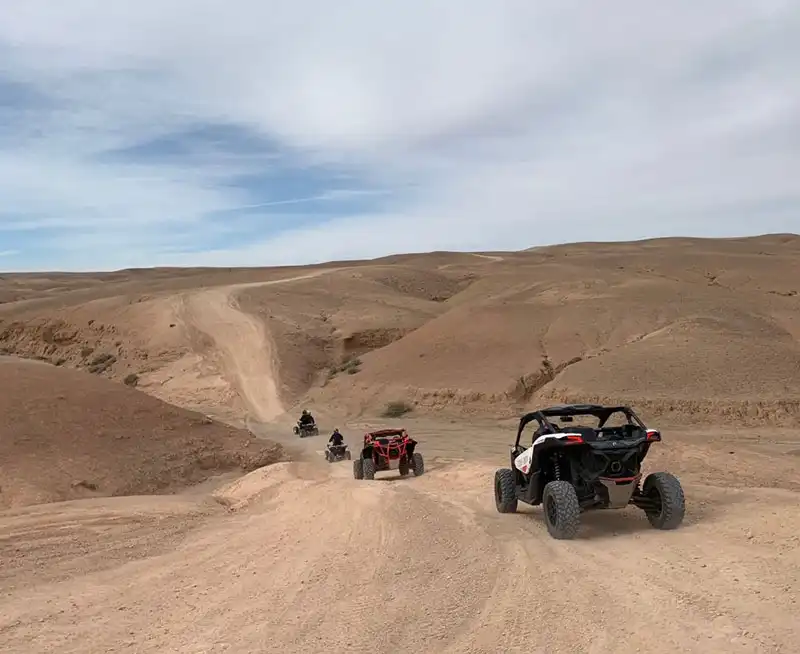
The gentlest of the four options involves a Marrakech base with day trips into the High Atlas foothills near Imlil and, for families who want a taste of desert without the long drive south, an afternoon or overnight at Agafay, a rocky "reg" desert roughly 40 minutes from the city rather than the sand dunes of the Sahara. Mule rides on the tracks above Imlil need no skill and feel genuinely adventurous to a child. This works well for younger children or a first trip to Morocco.
Days 1-2: Marrakech
Arrival, medina souk hunt, and Jardin Majorelle. Families with older children sometimes add a hot air balloon ride at dawn on the second morning.
Day 3: High Atlas Day Trip
Mule ride near Imlil, plus a traditional Berber lunch.
Day 4: Agafay Desert
Afternoon or overnight at a desert camp, often built around a sunset dinner in the desert.
Day 5: Back to Marrakech
Pool day and riad downtime.
Days 6-7: Essaouira or a Second Mountain Excursion
A day trip to Essaouira or a second mountain excursion, followed by departure.
The South & the Sahara
Kasbahs, Dunes & One Big Night - our most-requested seven-day format.
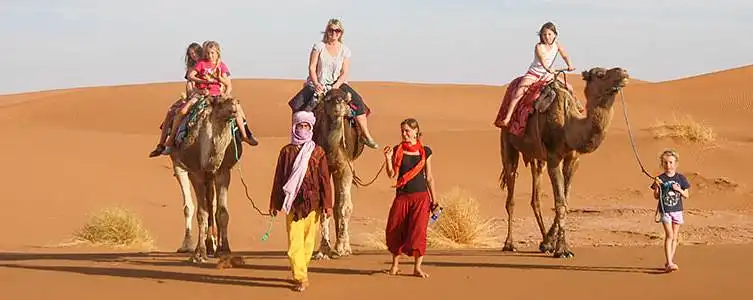
The classic version. Marrakech, the drive over the Tizi n'Tichka pass - one of the highest paved mountain passes in North Africa - then Ait Benhaddou, a UNESCO kasbah familiar to many children as a Gladiator and Game of Thrones filming location, where the towers can actually be climbed rather than admired from behind a rope, and a night at a desert camp near Merzouga. Two full driving days each way, which is why we generally suggest it for children five and up rather than younger ones. If the Sahara alone is the priority, our dedicated Marrakech-to-Merzouga tour covers the same route without the coastal or mountain extension.
Days 1-2: Marrakech
Arrival, medina souk hunt, and Jardin Majorelle.
Day 3: Marrakech to Ait Benhaddou
Tizi n'Tichka pass, kasbah towers.
Day 4: Ait Benhaddou to Merzouga
Ouarzazate stop, followed by sunset camel ride.
Day 5: Desert Camp
Free morning, dunes, early night, and sunrise.
Days 6-7: Return to Marrakech
With a Dades Gorge optional stop, and departure.
The Imperial Cities
Fes, Meknes & Living History.
A one-way route from Marrakech to Fes, whose medina is one of the world's oldest car-free urban centres, with Volubilis's Roman ruins as an outdoor break and Meknes along the way. The drive north is broken deliberately at the Cascades d'Ouzoud - well-known waterfalls where Barbary macaques are commonly sighted - making the journey more manageable for families than doing it in one long stretch. This one leans more cultural than the others: tanneries viewed from balconies, a zellige tile workshop, less time in transit and more time in cities. Better suited to children eight and up who engage with history when it's tactile rather than lectured.
Days 1-2: Marrakech
Medina and zellige tile workshop.
Day 3: Marrakech to Ouzoud
Waterfalls, plus Barbary macaques - breaking the drive north in two.
Day 4: Ouzoud to Fes
Shorter second driving day.
Day 5: Fes
Medina and tanneries from the balconies.
Day 6: Meknes & Volubilis Day Trip
Bab Mansour plus the Roman ruins.
Day 7: Departure
From Fes (or Casablanca, roughly 3.5 hours by road).
This route works best with an open-jaw flight plan - arrive in Marrakech, depart from Fes or Casablanca - rather than looping back for a long final-day drive to the starting point.
The North
Chefchaouen, Tangier & the Coast - the less conventional of the four.
The less conventional of the four options, and the one we recommend most for families who've already done a first Morocco trip. Chefchaouen's blue-painted lanes climb a hillside in the Rif Mountains, genuinely different from anything in the south. Tangier adds the Kasbah Museum, views across the Strait of Gibraltar to Spain, and the Caves of Hercules on the coast - a landscape of green hills and Atlantic light rather than desert. Shorter driving days throughout suit a wider age range.
Days 1-2: Casablanca or Tangier
Arrival and coastal medina walk.
Days 3-4: Chefchaouen
Blue medina, plus easy hikes nearby.
Day 5: Tangier
Kasbah Museum, and the Caves of Hercules.
Days 6-7: Atlantic Coast Day
And departure.
How to Plan a 7-Day Morocco Itinerary with Children
A few principles apply regardless of which of the four routes you choose, and they matter more with children than they would on an adult-only trip.
Don't change hotels every night. Unpacking and repacking daily is exhausting for everyone, but especially for young children who benefit from a predictable base. Two or three nights in each place, rather than one, makes a real difference to how the trip feels.
Plan for days with little or no driving. A week that alternates a travel day with a stay-put day holds up far better than back-to-back transit days, even if the total driving time is the same either way.
Don't underestimate Marrakech itself. It's tempting to treat the city as a one-night stopover before the "real" trip starts elsewhere, but children generally need a day or two to adjust before they're ready to engage with anywhere new - rushing through the first stop tends to cost more than it saves. Our guide on what to do before travelling to Morocco covers the practical side of that first adjustment.
Build in unstructured time. Not every hour needs an activity attached. A pool afternoon or an unplanned hour in a riad courtyard is often what makes the scheduled parts of the day work better.
Match activities to age, not to what looks good in photos. A souk treasure hunt engages a seven-year-old in a way that a guided historical walk doesn't, and the reverse is often true for a twelve-year-old.
Avoid turning every day into a guided visit. Some of the best moments come from simply walking somewhere with no agenda - a market, a beach, a village - rather than a monument with a schedule attached.
Understand why a private vehicle changes what's feasible. A fixed group tour has to keep moving on schedule regardless of how anyone's doing that day. A private driver can wait, stop, or turn around, which matters more with children than it does with adults.
Sometimes a longer single drive beats two shorter transfers. It sounds counterintuitive, but one real driving day with proper stops is often easier on a family than two shorter days that each involve packing, checking out, and re-settling somewhere new.
Which 7-Day Itinerary Works Best for Your Children's Age?
Age is a useful guide, not a rule - what your children are drawn to matters as much as how old they are.
Ages 2-4: Marrakech & the Atlas. The Marrakech and Atlas format is usually the easiest fit at this age - more time in fewer places, short day trips, plenty of downtime rather than long transfers. For families who prefer the coast, the same principle can be adapted around Essaouira.
Ages 5-7: The South, With Adjustments. The Sahara becomes genuinely possible, but the pace needs adjusting - more stops on the long driving days, and a comfortable camp with proper beds rather than a basic setup.
Ages 8-12: Sahara, Fes or the Atlas. The widest range of options opens up here - the desert camp experience, the Imperial Cities' history and workshops, or the Atlas's mule rides all tend to land well at this age.
Teenagers: Any Route, More Activity. All four routes work, but teenagers generally get more from routes with a physical or cultural edge - a surf session on the coast, sandboarding in the dunes, or genuine independence in a souk.
Best Time of Year for a 7-Day Family Trip
The best itinerary for your dates isn't always the same as the best itinerary in the abstract - the season genuinely changes which of the four routes makes the most sense.
A Sahara trip in July is a different experience from the same route in April - not impossible, but worth knowing before you commit to a date.
What All Four Have in Common
Whichever route fits, a few things stay constant across all four, and they matter more when travelling with children than they would on an adult-only trip.
A private vehicle changes what's actually feasible with a family. It means a stop happens when someone needs it, not when a schedule allows it. Bags stay accessible rather than buried in a shared luggage hold. There's no fixed departure time dictated by other travelers, and no group itinerary to renegotiate if a child falls asleep mid-drive and everyone would rather let them stay asleep for another hour. A restaurant choice can change on the spot if the first option doesn't suit picky eaters. An unplanned photo stop doesn't hold anyone else up. And if a child is unwell, the whole day adjusts rather than the family falling behind a group that keeps moving.
None of the four requires an internal flight. That's a deliberate choice: flights save time on paper, but they add airport logistics that rarely suit young children, and the drives themselves - the Tizi n'Tichka pass, the Draa Valley, the Rif hills - are consistently among the things families remember most, not the parts they endured to get somewhere else.
And every version travels with a driver used to families specifically, not a general-purpose guide adapting on the fly. That's a smaller detail than it sounds - it shows up in which roadside stops get suggested, how driving days get paced, and how quickly someone notices when a child's had enough for the day.
Seven Days Is Enough - If You Don't Try to See Everything
The itineraries that work best in a week are rarely the ones that try to compress the whole country into it. Morocco in miniature - a night here, a night there, four regions in seven days - tends to leave families with a blur of hotel rooms and driving, not the specific memories that actually stick: a mule ride above Imlil, a sunrise over the dunes, tanneries seen from a Fes rooftop, blue lanes in Chefchaouen.
One region, done at a pace that leaves room to actually be there, consistently beats four regions rushed through. That's the principle behind all four routes above, and it's worth keeping in mind even as you adjust the specifics to your own family.
7-Day Morocco Itinerary FAQ
For broader questions about the trip beyond the itinerary itself - including whether Morocco is safe to visit right now - see our other travel guides. The questions below focus specifically on this seven-day format.
Is 7 days enough for Morocco with children?
Yes, if the trip stays focused on one region rather than trying to cover the whole country. Seven days comfortably covers Marrakech and the Atlas, or Marrakech and the Sahara, or the Imperial Cities, or the North - each done properly. Trying to combine all of them in a week usually means too much driving and not enough time actually being anywhere.
Which Morocco itinerary is best with toddlers?
The Marrakech and the Atlas format, which keeps driving to a minimum and avoids the cold overnight desert bivouac that's genuinely difficult for very young children. A Marrakech base with short day trips works better for ages 2-4 than any of the longer circuits.
Can we visit the Sahara in a 7-day trip?
Yes, though it takes up a significant share of the week - two full driving days each way to reach Merzouga, plus one night at the desert camp. For children five and up this generally works well. For younger children, or families who want the desert without the driving commitment, a day trip or overnight to Agafay near Marrakech is a shorter alternative.
How much driving should we expect?
It depends entirely on the route. Marrakech and the Atlas involves relatively little driving - day trips under two hours. South and the Sahara is the most demanding, with two long driving days, often 6-7 hours depending on stops. The Imperial Cities and the North fall in between, and both can be structured with a stopover to break up the longer legs.
Can the itinerary be changed during the trip?
Yes. Every itinerary travels with a private driver rather than a fixed group schedule, which means a later start, a changed stop, or an extra rest day can be accommodated on the road if a child is unwell or the family simply wants to adjust the pace.
Is a private driver better than renting a car with children?
For most families, yes. A private driver removes the need for a parent to navigate unfamiliar mountain roads while also managing children, allows both parents to be present for the journey, and means the vehicle and pace can be adjusted without renegotiating a rental agreement.
Further Reading
- Morocco National Tourist Office (ONMT) - official Moroccan tourism body, for entry requirements and general travel advisories
- Toubkal National Park - official information on the wider park the Atlas day trips in this article sit within
Written by
Said, Senior Guide and co-founder of Morocco Tours. A former mountain guide, Said has been a guide certified by Morocco's national tourist office since 2009.
Most families know within a few minutes which of these four feels right - it's usually less about Morocco and more about what kind of trip you're after. Once you know which style fits, the exact route becomes much easier to build - we adjust the stops, driving days, and activities around your children's ages rather than fitting your family into a fixed seven-day schedule.
Explore Morocco Family Tours → · Plan a Private Trip →
You may also like: 10-Day Family Itinerary Ideas · 5-Day Family Itinerary Ideas · Marrakech Travel Guide · Morocco Desert Tours